Led user research to uncover the unspoken needs of hospital workers using meal-delivery services and proposed a group-delivery solution that better supports their workflow and constraints.
Role
Lead Product Designer
UX Researcher
Timeline
Sept-Dec 2023
Team
4 Designers
Tools
Figma
Figjam
Adobe Premier Pro
Skills
Field research
User testing
Ethnographic filming
User centered design
PROJECT OVERVIEW
DoordasDoorDash sponsored our user-centered design course to explore new opportunities within hospital environments—spaces with unique constraints, routines, and demands. Our team was tasked with understanding the daily rhythms of hospital staff, identifying unmet needs around food access and delivery, and developing product strategies that support convenience, speed, and hyperlocal demand. Through contextual research, interviews, and experience mapping, we uncovered key friction points in how healthcare workers order, pick up, and share meals during demanding shifts.h sponsored our user-centered designed class to ....
THE PROBLEM
Healthcare workers operate on unpredictable schedules with limited breaks, making it difficult to coordinate food delivery in a timely and cost-effective way. Individual orders often result in high delivery fees, inconsistent timing, and logistical challenges when picking up food in large hospital campuses. Existing delivery solutions lack systems that support the communal, fast-paced nature of hospital environments—leading to missed meals, cold food, and unnecessary stress during already high-pressure workdays.
THE SOLUTION
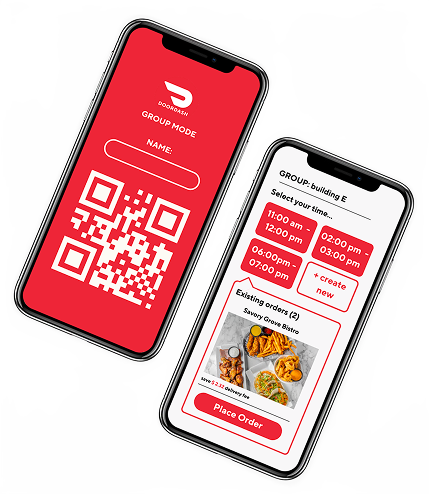
We designed Group Mode, a feature that streamlines food delivery by allowing hospital staff to form or join shared meal orders.
-
Users can create or join groups through QR-code invitations, making coordination fast and effortless.
-
The platform displays active time frames, participating restaurants, and the savings generated by consolidating orders under a single driver.
-
Staff members choose the time frame that fits their break schedule, reducing delivery fees, minimizing wait times, and improving order reliability.
This solution supports the collaborative nature of hospital teams while giving workers more flexibility and predictability in their day.
USER RESEARCH
To better inform the direction of my design process, I gained quantitative and qualitative insights through the following research methods:

Field Research
Visited Emory University Hospital to observe delivery workflows, understand staff meal-time constraints, and identify breakdowns in the current pickup process

Interviews
Conducted in-depth interviews with clinical non-nurses to uncover their pain points, motivations, and unmet needs regarding meal delivery
Explored how shift timing, location constraints, and hospital policies shape their ordering behaviors

Online Surveys
Distributed targeted surveys to hospital workers to gather broader quantitative data on ordering habits, meal-timing patterns, and delivery frustrations
Identified key trends and validated findings from interviews and field observations

Key Takeaways
Only one pickup location
Hospitals typically allow deliveries at a single designated drop-off point. Many staff must walk across the hospital to retrieve their meals—something that isn’t always possible during tight breaks and is especially inconvenient depending on where their unit is located. In many cases, it’s faster to walk to the cafeteria instead.
Driver confusion & mis-deliveries
Delivery drivers often struggle to navigate complex hospital campuses. With limited approved drop-off zones, many pull into emergency lanes or incorrect entrances, causing misplaced or delayed orders. This not only frustrates workers but also creates safety concerns, as these lanes are critical for emergency operations.
Meal options during shifts
Staff do have several options for meals, including the on-site Asbury Café, vending machines, nearby campus cafés, and the ability to bring food from home. However, these options don’t always meet the need for convenience, variety, or timing during demanding shifts.
FIELD RESEARCH
We visited a local hospital and spent time shadowing clinical non-nurses throughout their shifts to understand how they access meals within the constraints of their workflow. We observed their break patterns, location limitations, and the challenges of coordinating food delivery in a fast-paced environment. Alongside this, we tested the delivery process ourselves—from ordering to pickup—to experience the friction points firsthand. These field sessions also helped us build rapport with staff, allowing for continued feedback as the project progressed.
Additionally, we produced an ethnographic film to document the realities of meal access within the hospital—observing workflows, gathering candid moments, and visualizing the challenges staff face during their shifts. Contact to view footage

Key Takeaways
Cost sensitivity is the biggest driver
Participants consistently emphasized that discounts, coupons, and savings heavily influence where and whether they order. Special incentives for healthcare workers or group orders were especially appealing.
-
“Of course, I always try to save as much money as I can.”
-
“Discounts and coupons… will probably be attractive to me and the team as well.”
Meal options exist — but aren’t always ideal
Staff rotate between several options—Asbury Cafe, vending machines, nearby campus cafés, home-packed meals—but none fully meet their needs for convenience, affordability, or timing. Delivery becomes the go-to for special occasions or when someone is willing to pay more for convenience.
Group orders are logistically difficult
Coordinating large orders for staff events (e.g., Lab Week) is time-consuming and unreliable. Teams often struggle to find restaurants willing to prepare high-volume orders at specific times.
-
“We have to somehow find a pizza place that’s going to deliver ten pizzas at noon… then ten more at 5 p.m.”
Delivery is used selectively, not routinely
Doordash is primarily used for:
-
Group events (e.g., Lab Week)
-
Team meals
-
“Last resort” moments when staff don’t have time to leave their unit or want something beyond cafeteria options
What factors influence whether clinical staff choose delivery during a shift?
How do price sensitivity, discounts, and promotions shape their ordering decisions?
What challenges arise when coordinating large or repeated group orders for teams?
How do staff currently navigate existing meal options during shifts, and where do gaps remain?
In what scenarios does Doordash become the preferred option over on-campus or cafeteria choices?
USER INTERVIEWS
We interviewed 3 clinical non-nurse staff members at Emory University Hospital to understand how they manage meals during shifts, when and why they turn to delivery services, and what factors influence both individual and group orders. We began by discussing their typical eating patterns and cafeteria use, then shifted to their experiences, frustrations, and expectations surrounding food delivery—specifically Doordash.
What drives loyalty to a delivery service
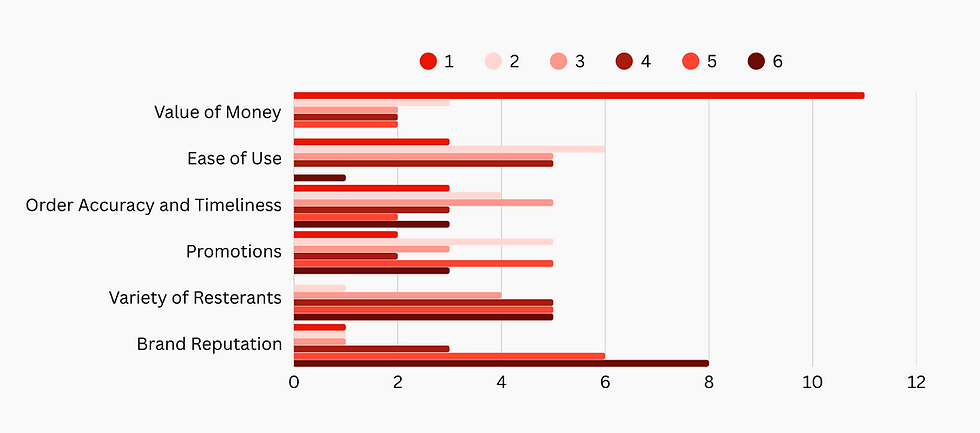
When asked to rank the factors that most influence their loyalty to a food delivery platform, respondents consistently prioritized:
-
Value for money
-
Ease of use
-
Order accuracy & timeliness
These findings echo our interview insights: hospital staff are highly cost-conscious and rely on services that are simple, predictable, and reliable during tight, unpredictable shifts.
Pain points when ordering to the hospital
We also asked participants to identify the most common challenges they face when using food delivery services in a hospital environment. The top issues were:
-
High delivery fees
-
Delivery delays
-
Lack of promotions or discounts
These results highlight the key friction points that discourage regular use and reinforce the opportunity for a more affordable, hospital-aware solution.

SURVEY RESULTS
To supplement our interviews—which were limited due to the demanding schedules of hospital workers—we distributed a tailored Qualtrics survey to clinical non-nurse staff at Emory University Hospital. Our goal was to gather broader quantitative data around meal habits, delivery preferences, spending behavior, and factors influencing loyalty to food delivery services.
We received 16 responses, providing a helpful snapshot of how hospital workers make decisions around ordering food during shifts.
KEY INSIGHTS
In the hospital setting, healthcare workers' loyalty to food delivery services depends on how they perceive the value for money, the ease of using the service, and the accuracy and timeliness of their orders.
The primary obstacles preventing healthcare providers from ordering food at work are the additional fees, delivery delays, and the absence of promotional offerings.


FRAMEWORKS
From these research methods, we gathered a substantial amount of both quantitative and qualitative insights. To make sense of this information, I organized the data into several frameworks, enabling us to analyze patterns, prioritize findings, and identify opportunities more effectively.
OPPORTUNITY SPACES
Reduce the Physical & Cognitive Burden of Meal Pickup
Hospital workers often cannot leave their unit or walk across the hospital during short breaks. A more flexible, unit-level or group-based pickup system could reduce travel time, protect break windows, and ensure meals are actually accessible when needed.
Improve Delivery Reliability Within the Hospital Environment
Drivers frequently get lost, choose incorrect entrances, or block emergency lanes due to confusing campus layouts. A clearer, hospital-specific delivery flow—or coordinated group delivery point—can reduce delays, prevent misdeliveries, and minimize operational disruptions.
Make Food Delivery More Cost-Effective for Healthcare Staff
High fees, limited promotions, and infrequent discounts discourage consistent use. Since cost-saving is a major motivator, there is an opportunity to introduce group-order incentives, bundled delivery options, or hospital-specific pricing to better support workers’ needs.
THE SOLUTION

GROUP MODE
-
Enables users to form or join groups for shared meal orders.
-
invite members via QR codes
-
-
The platform displays existing time frames with an order, showing chosen restaurants and potential savings for joining.
-
Users select preferred time frames, consolidating orders under one driver, minimizing fees, and allowing personalized delivery schedules.